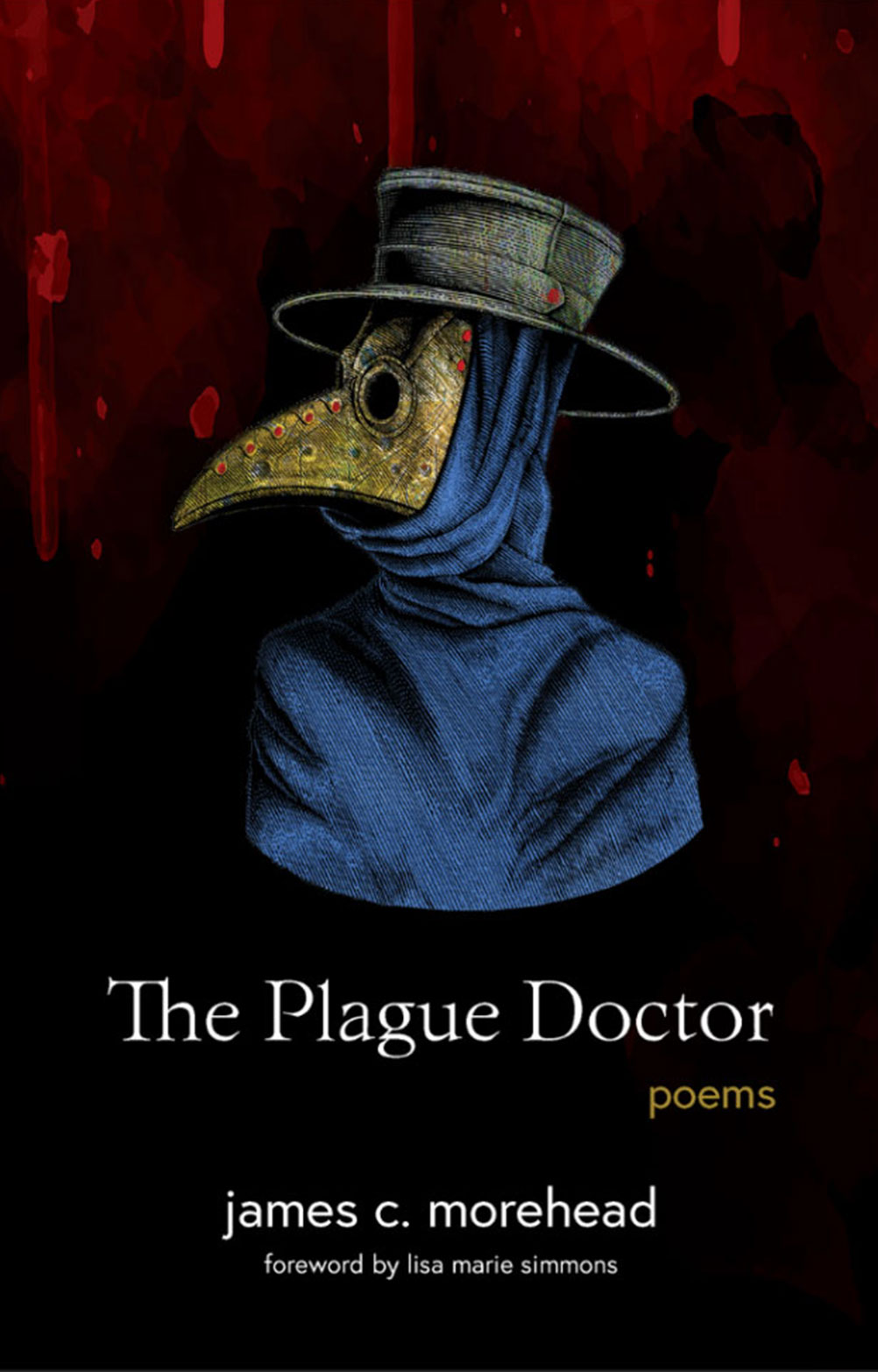
The joy and challenge of writing poetry is the long journey from an initial image or idea, to a revised and edited poem that is worthy of publishing. For many years I wrote all of my poems longhand, with edits made on top of the poem, with scratch outs and column notes, until the poem was such a blur that I copied the latest edit to a clean page. My poems now are all written using Google Docs so that I can write at night in bed, using dark mode, without my wife (justifiably) banishing me to another room. A cool side effect of writing all my poetry using Google Docs is a complete revision history. Below is a timeline of revisions and edits made to a poem from my latest book (The Plague Doctor).
The poem also appeared in Beyond Words Magazine, Issue 24 (March 2022) and was set to music by Deon Nielsen Price for baritone and piano (premiered November 14, 2021, at the Presidio Chapel in San Francisco). I’ve chosen this poem because of how significantly the poem evolved during the revision and editing process.
Key takeaways for aspiring writers:
- The best way to start writing a poem is to just write, unconstrained, without overthinking what the poem is about, the form, or any of the many details that will need to be considered to craft a final edit.
- Be open to complete re-writes and cutting your “darlings” (phrases you love but ultimately don’t work).
- If you get stuck, set the poem aside for weeks (even months) so that you can revisit the poem with fresh eyes, and without artificial urgency to get the poem done (unless there is a hard deadline, which has been the case with projects connected to my role as Poet Laureate for Dublin, California).
- Seek out critical feedback from other poets.
- Read the poem out loud – even just to yourself in the mirror – or better yet friends and family members. Hearing a poem out loud is very different from “hearing” a poem in your mind.
- Ask a friend or family member to read the poem “cold” and observe where they stumble or get tripped up.
- Finally, be cautious about overworking a poem.
Below is a subset of the twenty four versions of the poem from the initial middle-of-the-night idea to the final published version many months later.
[April 28, 2021, 4:52 AM] Here is the raw first draft (I couldn’t sleep!) – just a stream of unedited images. The best way to start writing a new poem is to just write. The poem will emerge later during the revision and editing process. The idea that kept me awake in the middle of the night was entering a gallery where each room represented a different art form, and when entering each room the form of art dissolved into the floor. The screenshots below are taken from the Google Docs revision history for the poem.
gallery

in this room the books are stacked in ordered piles each spine unbroken phrases slowly slipping through the pages letters jumbled and tumbling toward a drain by the door leaving pages blank to be filled once more

in the next room walls are filled with paintings some delicate etchings in black others an explosion of color one just a single frame of pure blue masking five thousand fevered brush strokes each canvas letting go of ink oil and pigment dripping until the swirling colors blend filling the floor in black leaving four walls of patterned white tiles

leaving words and paint behind the next room is stuffed with carved clay marble teak one a missive figure bent over contemplating life another anguished her closed eyes open mouth howling in the night and one more an abstract something impossible to untangle but these too slowly melt the marble flows like lava the clay unfired melts teak retreats in dust

the final room it's only me curved walls lined with seamless mirrors the ceiling a single apot of light the floor pure white drawn to its center looking back the mirrored walls creep closer in the entrance door disappears i'm reflected front to back the light goes dim and like those before i melt into the gallery floor
[April 28, 2021, 8:23 AM] Morning gives me fresh eyes and I start taking the raw material from the middle of the night and re-working.

[April 28, 2021, 10:38 PM] – Multiple short editing sessions during the day and the poem is taking an early form. Still just a jumble of images and ideas.


[April 28, 2021, 10:41 PM] I’ve left out a number of more minor edits – this is one example. When a poem is going through the revision and editing process that can involve major re-writes and smaller edits.

[April 29, 2021, 10:42 PM] This poem was a challenge – I loved the idea of the poem but struggled to find the right form and structure, resulting in multiple re-writes.

[May 1, 2021, 7:53 PM] The poem continued, at this point, to have a rhyming scheme which largely disappeared in the final edits.

[May 1, 2021, 9:50 PM] It was at this point that I had the idea of each stanza growing, one line at a time, with the lines intending as a visualization of going deeper into the gallery.


[May 2, 2021, 4:16 AM] The poem is now much closer to what the poem would ultimately become and the edits are more targeted. The ending, as is so often the case, wasn’t working.


[May 2, 2021, 11:30 PM] Or was the poem near its final form, not really; major revisions can happen at any point. This is one of those major revisions.


[May 10, 2021, 11:32 PM] It was at this point that I wasn’t satisfied with the poem, I made a few more edits and then set it aside for over a month.

[June 16, 2021, 10:55 PM] I came back to the poem a month later with fresh eyes and, as a result, less “revision fatigue”.

[June 18, 2021, 5:13 PM] This is the edit that had me confident there was a poem, up to this point I wasn’t sure if I’d ever finish this piece

[August 27, 2021, 11:10 AM] There are really two versions of this poem – this version and the most recent edit that appears in The Plague Doctor. This version was set to music for baritone and piano (video of the performance at the bottom).

And this is the Final version for The Plague Doctor (photograph by James Morehead), with tightening edits and a new title (that serves as the first line of the poem), suggested by my editor Kristina Marie Darling.

Finally, here is the poem set to music by Deon Nielsen Price for baritone and piano.



It was so interesting to follow along with your editing process. It is indeed arduous and sometimes difficult to stick with a particular poem after working on it for a long time. I enjoyed you reading your poem and the performance as well.