AE Hines is the author of Adam in the Garden (Charlotte Lit Press, 2024) and Any Dumb Animal (Main Street Rag, 2021). He has won the Red Wheelbarrow Prize and Palette Poetry’s Love and Eros Prize, and has been a finalist for the Montreal International Poetry Prize. His poems have been widely published in such journals as The Southern Review, Rattle, The Sun, Prairie Schooner and Alaska Quarterly. And his literary criticism can be found in American Poetry Review, Tupelo Quarterly, Rain Taxi, and Northwest Review. He received his MFA from Pacific University, and resides in Charlotte and Medellín, Colombia. More at www.aehines.net
Below are excerpts from the interview with James Morehead on the Viewless Wings Poetry Podcast.
James: I’m excited to discuss your book “Adam in the Garden”, which has an incredible cover by the way. They say, “Don’t judge a book by its cover,” but that’s nonsense. When I go through bookstores, I judge all kinds of books by their covers.


A.E.: “You know, it’s funny you say that because one of the reasons I chose the cover was to make a statement. The title of the book, ‘Adam in the Garden,’ might mislead someone into thinking it’s about Genesis, so I tried to choose a cover that would prevent that misconception.”
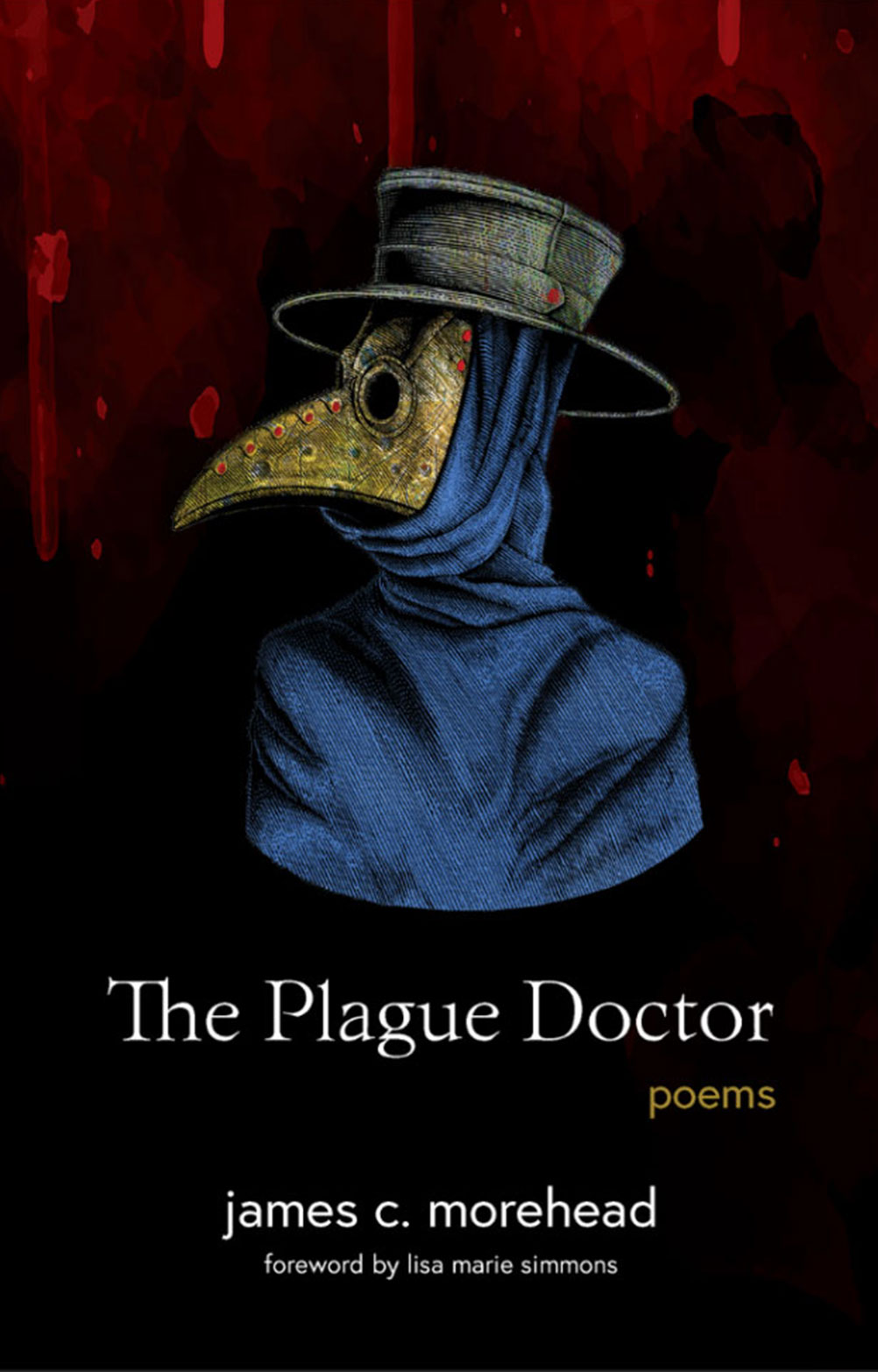
James: It’s like the cover for my latest book, “The Plague Doctor” is very clearly a medieval figure on the cover because I didn’t want people assuming it was about the pandemic, which it’s not? The poems in ‘Adam in the Garden’ are deeply personal, intersecting sexuality and the natural world. What poets have inspired your voice, and challenged you to strive for more?
A.E.: “I had the good fortune recently to spend time with Jericho Brown, a poet who’s really making waves, especially after winning the Pulitzer for ‘The Tradition,’ which was well-deserved. I first discovered his work in 2015 with his book ‘The New Testament.’ Before I’d published any poetry, his work really inspired me. But it’s not just him; Tony Hoagland has been a significant influence, as has Andre Hollander from Oregon, a fabulous poet who has been a mentor to me. Occasionally, you come across a poet who really pushes you to elevate your craft. Marvin Bell once said the process of writing should involve alternating between reading and writing, and that’s something I try to embrace. You always need to be on the lookout for those poets who challenge you to push harder and try new things. Jericho certainly did that for me.”
James: A recent interview featured Ellen Chang-Richardson, who creates very visual poetry. The visuals are so integral that performing it can be tricky. They use a loop pedal to layer spoken words over loops, which enhances the poem’s visual impact. It’s stuck in my head now, and I’m thinking of experimenting with a loop pedal myself.
A.E.: “It’s interesting because I was just teaching a class on revision and discussing how poets can use tools like repetition and sonic echo if they don’t typically write strong images or metaphors. Lucille Clifton, for instance, used rhyme and repetition effectively, often without heavy reliance on imagery. The idea of using a loop pedal is something new to me, but it’s fascinating. I read recently that the number of people reading poetry has nearly doubled in the last five to ten years. A poet friend and I joked that this means there are 28 million poets in the United States, which challenges the old notion that only poets read poetry. Young people are the largest demographic engaging with poetry, which means we need to find more innovative ways to perform poetry to meet their expectations for performance and multimedia. It’s an exciting time, and I expect we’ll see a lot of creativity from younger poets in these areas.”
James: In “Naturalization” you write:
beneath the electric barbwire
              of US Immigration.
              In Houston, I watched
badged women and men

berate brown men in shackles
              while they sat tethered
              to stiff chairs beside us.
Most stared at their shoes.
When grounding a poem in your personal experience how do you balance being true to the experience, but also being true to the poetry you are crafting, so that the result is poetry not a documentary?
A.E.: “That’s a great question. I take advice that Richard Hugo gave in ‘The Triggering Town,’ his craft book, where he emphasizes that the emotional truth is what’s important, not necessarily the factual truth. The individual details can change to fit the poem. I noticed recently that I had made myself 21 years old in two different poems, which couldn’t possibly be true. I mean, maybe I was 24 in one and 21 in the other, but 21 sounded better to the music of the poem. That was just fine. If you’re using an ‘I’ in a poem, I think it needs to be grounded, especially if that ‘I’ is going to be interpreted as the poet. It’s somewhat misleading to create from whole cloth, so I try to make sure that the surprising facts, the things that stand out in the poem as the factual basis, are not from whole cloth if I’m writing a more personal poem, which tends to be my style. I’m usually sparked by the sensory experience of being alive, which makes me want to create poems and play with language to express the world in words. But it has to be a story; if there isn’t a story, it doesn’t tend to grab me.”
James: Absolutely. I also agree that when incorporating things that are truly personal, I try to keep them as close to reality as possible, with little tweaks to ensure it’s still poetry.
A.E.: “Yes, exactly. But I will say, the liberties I take sometimes… I remember saying, ‘this is mostly true,’ and what I meant by that was, for example, one lover in the poem was really an amalgamation of three over the course of a decade. But for the purpose of the poem, this experience was all true. I had a student recently who wrote a poem. I loved it. The line was, ‘I do know facts, but I will tell you the truth,’ and it really stuck with me because I think as long as the facts are massaged enough to work within the poem, as long as the truth is still there, it works. I’m a big believer that you can’t get your whole story into a poem. I tend to get really nervous if I go past a page. A page and a half is where I basically say, ‘Boy, I’ve got to wrap this up.’ That’s how it’s been thus far.”
James: Really long poems worry me. I’m concerned that I’ll spend all my time editing the beginning and the ending, and the middle will suffer because of that. I typically tap out at about a page, page and a half.
A.E.: “I think of writing a poem as spell-casting, trying to create a spell for the reader that keeps them entranced for a certain amount of time. It’s hard to sustain that energy for a long time without the poem collapsing on itself. I feel the exact same way about the middle. It’s like, ‘Okay, how much of this can I get rid of?’ And then that’s how new poems emerge.”
James: In “To My Flirtatious Friend Who Made a Pass at My Husband on Facebook” you close the poem with:
I wanted him then the way the beans
long to be ground and pressed,
then pummeled by relentless steam.
This poem excels in two areas that are a challenge for poets: titles and endings. When revising and editing a poem what are you striving for in a title and ending, using this poem as an example?
A.E.: “This poem is very factually true. It’s always fun to go to readings and read the title and then point out at the audience and go, ‘You know who you are,’ which is funny because everyone looks around. I find titles the most difficult part, and I usually walk around saying, ‘God, I suck at writing titles.’ But it’s usually the very last thing I settle on. I write the poem until I find the ending, but I think that’s true for every poet—anyone can start a poem, but it takes a poet to get out of one. The ending has to surprise me in some way. I have to discover something. In that poem, the surprise wasn’t that this person was beautiful or attractive, which had been validated by an external third party to my chagrin, but it was the fact that he was there, that moment in the morning. The smells and sounds referenced at the end are about that discovery. I just had to figure out how to tidy it up with that discovery. If there’s a bit of a gut punch at the end of a poem now, I know I’ve sort of got what I sometimes describe as searching for what the poem wants to be, why it exists. The ending tells me why the poem wants to exist because my job is to help it come through, not that I’m making it. Then the title becomes about how to best enter the poem. The title and the first line need to get the flywheel rolling enough that the reader is carried through to that end, to that discovery. I search for a title that does that.
“This one was easy because it was truly a reaction to a real event—I was kind of pissed off when it happened. I didn’t think this friend realized whoever came across his Facebook page was my husband. It was very awkward, but it was so obvious; the direct facts were the best possible title, and using a semi-conversational, semi-epistolary form seemed to work. I’m glad you liked it. I usually include that poem at every reading because it gets a laugh.”
James: I think that the examples of both the title and ending are perfect. I had a poem called ‘Stage Fright,’ which was very functional. A friend of mine, a poet, told me, ‘You have to change that title. It’s too banal.’ So I changed it to ‘That Time I Was Left for Dead Downstage.’
A.E.: “I mean, you allude to a story, right? It makes me curious what happens inside the next few stanzas.”
James: And coincidentally—but I don’t think purely coincidentally—it was placed immediately after I changed the title, and nothing else changed. And your point about not worrying about knowing the ending before you start writing. I think very rarely do I have any idea what the poem is even about when I start writing. I find the best way to start writing is… just to start and then figure it out.
A.E.: “I think that’s so important. Knowing what you’re going to write is death to a poem. ‘No surprise for the writer, no surprise for the reader,’ as the old adage goes. I remember Dorianne Laux, one of your California poets and one of my mentors in my MFA program, said, ‘If you know what you want to write, that’s an essay, not a poem.'”
James: The poem “The Devil and the Bartender” screams out to be turned into a Dylanesque ballad with lines including:
Like the rest of them, he can't shut up
about his girl troubles. Goes on
about that first woman who still won't
return his calls, can't forgive
that long-ago madness with the tree.
Another thread running through your collection includes references to Christianity, but not pious references. What is the backstory of this poem? Have you thought about turning this into a song? It almost reads like song lyrics.
A.E.: “I hadn’t thought about it, but you’re intriguing me. The funny backstory of this poem involves two things. One, I was stuck and couldn’t write at one point. I had finished my first book and was trying to figure out what kind of poems I was going to write next. My mentor, Hollander, suggested I write persona poems. She would give me these assignments, like making a list of things I see in the environment and writing a poem from them. I initially resisted because I didn’t know how to write persona poems. But that was the poem I wrote. In retrospect, my first book and even this book have a lot of father-son relationships, and a theme of walking away from family because of dysfunction. I realized I wanted a different lens through which to explore father-son relationships. There’s another poem in the book called ‘The Fall,’ which describes me walking away from my family as a young person because of the violence and dysfunction. Yet, doesn’t every child long to go home? Doesn’t every child wish they could have had a good relationship with a parent? So, I used that persona poem as a way to talk about my dad and me, or even how I feel sometimes with my own son, in a different way. But I appreciate you bringing it up because I almost never read that poem out loud. I don’t feel it’s as sonically full or musical as the language I usually like to use. It was also a different voice. I realized with persona poetry, you don’t even have to be the poet anymore, which is quite liberating. It’s something I think I want to experiment more with as I write going forward.”
James: I’d like to zoom in on a specific form technique you’ve employed in several poems – double-spacing. “Paper Anniversary” and “Hummingbird” are two examples. In this collection was the decision to double space driven by the poem, giving the lines room to breath, or how the poems appeared in spreads with their neighboring poems? Or a bit of both? My assumption is that everything a poet does, is done with intention.
A.E.: “At that time, I was doing a lot of experimentation in the book, trying to stretch my wings and figure out different ways of writing. For example, there’s a poem in the book that uses a broken form with no punctuation, but it’s the only one like that. Over the last couple of years, I fell in love with Enrique Molina and his sonnets. I’m assuming every poem you saw that was double-spaced was probably 14 lines. I experimented with writing more Americanized sonnets in this book, and I liked how double-spacing some of those poems, and arranging them next to each other, worked for aesthetic purposes in the book—as long as it still worked with the language. Now, I’d like to write an entire book that is double-spaced. What I really love about the double-spaced poems is that it calls attention to the fact that they were in sonnet form because it really sets off each line as its own singular unit of music. I think we sometimes forget that poetry is a visual form as well. In this collection, I was really playing with the field of the page more, and not in a particularly novel way compared to other artists, but it was definitely something that caught my attention.”
James: “On the Nature of Time” is one of my favorite poems in this collection, deeply personal about a potential medical risk, and so universal, the passage of time compared to an aging hammock. How does poetry help you navigate challenges in your life?
A.E.: “My first book was written when I was going through my divorce from my first husband after 20 years, and that book probably wouldn’t exist had I not gone through that. I’m very happily remarried now, and this book explores a lot more of that happiness. My current husband, who’s Colombian, once asked me if I could write happier poems, to which one of my poet friends responded, ‘These are the happy poems.’ It’s not that I don’t think there are joyful poems in my work—I think there’s much more joy in the second book than the first—but I believe joy sort of takes care of itself. Sometimes, when you go through tough moments that make you question what you believe or remind you of our mortality, poetry is like the friend that reaches out its hand when there’s no one else around. For me, not only reading poetry but also writing it helps me to take something I’m going through and sort of…resolve isn’t the right word, but it helps me to sit with the questions clearly, which is often enough. Poetry helps me clarify the questions, not the answers.
“I’m in my early 50s now, and it’s the age when we start to notice that the body won’t last forever. Things start to go wrong, we begin having various minor procedures to fix things, and we hope they’re benign. This poem was actually sparked by a colonoscopy that was supposed to be routine—my first one. The doctor found something and told me I’d have to come back a year later for the next colonoscopy and now I’m on a frequent flyer program with the gastroenterologist for the rest of my life because I’m at risk. That was surprising to me. And I remember thinking about James Wright’s poem, lying in a hammock at William Duffy’s farm—though I often mangle the title—and here I was, lying in a hammock in Colombia after receiving this warning that I was going to be high-risk for colon cancer, and it hit me: time runs out when you don’t expect it. You never expect it. So, a lot of this book is about how people begin to leave us as we age. We’re at the top of the hill, knowing that gravity will take care of the rest—it’ll just pull us downhill. And the book talks about reckoning with that in a way.”
James: I can relate to the colonoscopy references as I’ve gone through a couple of those and thankfully haven’t had any bad news as a result. But definitely, it’s a situation where you go in not sure what to expect.
A.E.: “Especially now, yeah. Well, they’ve started telling people to get colorectal screenings starting at age 45. So, in your podcast, we can basically tell everyone that if you’re 45 or older, you should be getting a colorectal screening. It’s a public service announcement.”
James: Don’t put it off. It’s an excuse to watch Netflix all weekend.
A.E.: “Absolutely. Exactly right.”
James: “Incarnation” is beautifully brutal poem, with lines including:
You think you made me, Father? Taking
that girl, slight and virginal, wedding her
across state lines where officials asked
no questions, then breaking her like a horse
when she begged for tenderness, pleading
for a hospital when the bleeding wouldn't stop.
How do you decide what you include and what to edit out when sharing such intensely personal vignettes in your poetry?
A.E.: “I get that question a lot. I’m very sensitive, particularly about including details about my son. There are things I will not write about, and certainly wouldn’t write about without his permission, because I feel as though it’s his story and I’m his parent. However, I have a different stance when it comes to the stories I experienced as a child through the stories of my parents, whether they told me or through the direct experiences I had with them. I feel more freedom to use those because I consider them part of my story, part of my ancestry.
“It’s interesting, I don’t go by A.E. Hines in real life, but I publish that way. Everyone knows me as Earl Hines, and there was a famous jazz musician named Earl Hines. I was smart enough early on to realize that if people were going to find my written word, I better not use that name. There’s also a little side benefit of knowing that, like, I don’t think anybody in my extended biological family is reading any poetry, frankly. My mother probably would chew my liver out if she read some of these poems. Both my parents are alive, but we’re fairly estranged.
“To answer your question, I struggle with it. For example, there are poems in the book, and even in the first book, where I reveal things about my mother, and I often don’t read those in public. They’re in the book, but I don’t read them as much at readings. I read this one because it feels like it’s got a certain righteous anger to it. But I must have some sense of reticence relative to having that issue relative to my maternal relationship. But yeah, I think we’re allowed to tell our stories; they are our stories. But I think you do have to be sensitive. For example, I know other poets who wouldn’t publish those things without permission if the person was alive, and I’ve taken a different tack as it relates to parental relationships, but for the reasons I said, I think they’re my stories in that regard.”
James: Queer themes and explicit sexuality appear in multiple poems. “On Monogamy” is a particularly moving example that I immediately related to, years ago standing next to my now wife silently washing dishes, occasionally brushing hands. That beyond all the divisive politics and religious rhetoric, love is love. When incorporating explicit references in a poem, something I’ve never tried, how do you approach editorial choices, of being direct and explicit vs. more subtle and indirect?
A.E.: “It’s a fabulous question and it came up when I literally ended up changing publishers for this book due to some editorial disputes. The poem you mentioned, which was not about sex but about the body, faced pushback over the use of the word ‘anus.’ It shows that different people have different aesthetic sensibilities. I believe anything in the language is fair game in a poem. I don’t subscribe to the notion that certain words are inappropriate for poetry. Regarding description, I remember this same editor questioned some choices in another poem called ‘Security Deposit,’ which had one sexual reference and no direct sexual references in the poem ‘On Monogamy.’ Despite a book filled with queer eros, many are surprised that ‘On Monogamy’ isn’t a diatribe against it. In our case, I’m not preaching or advocating any particular lifestyle; I’m simply pointing out that in our case, we have what one would consider a very traditional relationship. I think it’s important to remind people that such relationships exist across the spectrum, including in queer relationships.
“Recently, I met a lovely family relocating from Florida—a gay couple with their two children, adopted from birth. The kids were being horribly bullied due to the regressive politics and anti-gay legislation in the state. This family is relocating because they don’t want their kids to feel ostracized, or have their teachers shut down conversations about their two dads out of fear for their jobs. Both of my books have raised a bit of money and awareness for causes like the Trevor Project out of California, highlighting that queer youth are four times more likely to consider suicide than their straight peers. If we don’t think that has something to do with how we treat our children, then whose children are they? Our politics and the language we use matter. As an artist, it’s important for me to speak truth about my queer experiences. I can’t talk about anyone else’s experience; all I can do is represent mine and hopefully remind people that we’re all human beings searching for love, connection, and acceptance. That’s why I write; I survived. My hope is that we get through this period of divisiveness more empathetic and united than we feel right now, despite the shrill voices in our culture that seem to be in the minority. If you can be a voice that says, ‘No, love is love,’ maybe that’ll help counterbalance that noise.”
Listen to the full interview on the Viewless Wings Poetry Podcast.

![Maria Giesbrecht on “A Little Feral”: Crafting Poems of Heritage and Healing [INTERVIEW]](https://i0.wp.com/viewlesswings.com/wp-content/uploads/2026/08/Maria-photo.jpg?fit=3265%2C4898&ssl=1)
![Allison Mei-Li Explores the Joys and Sorrows of Motherhood in “a history of holding” [INTERVIEW]](https://i0.wp.com/viewlesswings.com/wp-content/uploads/2026/03/Allison-Mei-Li-headshot-2.jpg?fit=1080%2C1350&ssl=1)
![Mikhail Iossel Explores Identity and Breaking from the Past in “Sentence” [INTERVIEW]](https://i0.wp.com/viewlesswings.com/wp-content/uploads/2025/10/photo-iossel.jpg?fit=483%2C949&ssl=1)
0 Comments