James: I want to start with Psalms from the Badlands being unique in its form of poetry: 150 untitled short poems, haiku-like in form. Before diving into specific poems and themes, what was your inspiration for creating a collection in this style?
Hosho: “Way back in 2007, I wrote a little chapbook for a press called Kinder-Steiner Editions, and it was 37 of these poems. I called them Psalms from the Badlands because they were poems about New Mexico. I had so much fun doing it that I thought, ‘Well, there’s 150 psalms in the Bible, so why don’t I just do 150 of these things?’
“And then, lo and behold, 17 years later, I actually finally finished. It took a heck of a long time, mainly because I didn’t push it. I just kind of let moments and things come to me and take them in different seasons. That was a big part of it. Seasons are a huge part of haiku, so I wanted there to be some years. I certainly didn’t anticipate 17 years, but I’m happy that it took as long as it did.”


James: I think that’s a good reminder to poets that unless you’re on some sort of hard deadline…
Hosho: “I mean, I don’t know who would be. You’d have to be tremendously famous for that to be happening, right?”
James: Exactly, which is I think maybe a blessing, because yes, I think some things just have to take the time it needs. And there are poems that rattle in my head, and I may not write them down for years and years, and they’re better served because of it.
Hosho: “I have a similar experience. There’s one poem in this book that I’ve probably been trying to write since I was a teenager. We’re talking about 35 years I’ve been trying to write that little poem.”
James: Less is hard. Short stories are arguably more challenging to write than novels. Writing short poems requires extraordinary attention to every detail. In number six, you write:
Spiderweb in scarlet sage—

     morning dew glistens,

     pearls on every thread.
As with every poem in this collection, the images are so intense and pure. How do you approach distilling a poem to its essence?
Hosho: “What usually will happen for me is I will have an image, I will have a thing that I’ve seen or maybe heard. But with this collection in particular, it started almost exclusively with images.
“Less is hard. Short poems are so much harder than anything longer because you’ve got nowhere to hide. If you don’t get it right, you don’t get it right, and that is it.
“I start with the image and then what the image would mean for me. I really feel like you have to get your image as tight and as almost cinematic as you can when you’re, you know, when you’re really trying to create a picture with words, and only a few words.”
James: While each poem stands on its own, the collection paints a rich portrait of a natural landscape. How did you approach the flow of this collection, including the choice of simply numbering the poems from one to 150, without section names or other guardrails for the reader? You mentioned 150 psalms, and that was how you expanded from a shorter collection to a longer collection. And you also mentioned it was built up over many years and different seasons. How did you approach the flow, especially given how long it took to get to the point where you felt it was worthy of being a book?
Hosho: “A project that takes this long, you’re not pounding on it and trying to make things work. You’re really just letting it happen.
“In terms of the flow and the kind of the organization of things after the fact, my process was to write things, go away from them for a while, come back and look at them, and then make some hard decisions about whether or not I felt they were strong enough to stay. Even though there’s 150, I’m certain I wrote way more than 200, maybe even more. Some of which I’ve saved because they were maybe too urban. I wanted this book to feel mostly like the natural world.
“So the approach was to, you know, let it come as it comes, to decide if it was strong enough. And then at the end, when I really felt like I finally had my 150, the only sort of organizational approach I took was to make sure that things that felt like they were in the same kind of vein weren’t right next to each other. I found through lines and threads that I didn’t anticipate. At the end you look back and you’re like, ‘Oh, this image is appearing, you know, across a few different poems, or this specific plant or this specific something is appearing.’ And looking at those things individually, I’m like, ‘Oh, this is this is a whole kind of tent pole or thematic thread. I’m certainly not clever enough to plan that out.’ It’s kind of magic that way when you get lucky like that.”
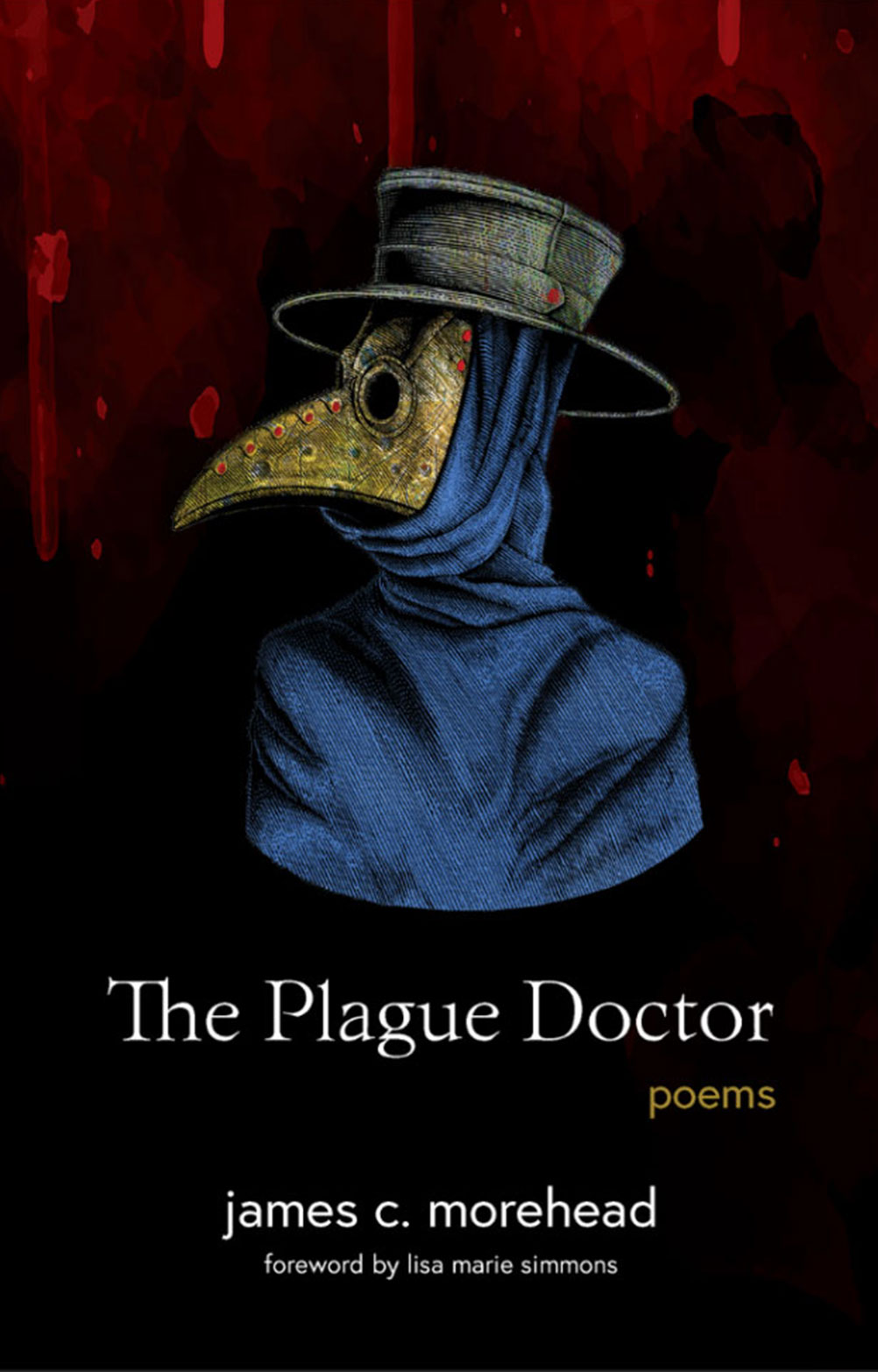
James: I think that that’s another good reminder is when you organize a collection, which is hard for poets, and we end up printing them out and putting them on the floor and moving them around in a physical space, is to not look for obvious, simplistic ways of grouping things, to have themes that you may not have even thought of emerge, things that are more nuanced. In my most recent book, The Plague Doctor, it ended up being Shakespearean in form with three acts. And it was completely different from anything I had in mind, and it was only when I saw everything together it was like, ‘Oh, there’s this little thread that exists that’s more nuanced’ versus, ‘Okay, these three poems happen to be about X so we’ll clump them together.'”
Hosho: “Right, yeah.”
James: I’m an avid hiker, and reading this collection gave me the sense of hiking when I’m disconnected from technology and just observing and interpreting what I’m seeing, hearing, and feeling. The poems felt like a narration while on a journey. Did you write the starting points of these poems while in motion? Number 19 is a good example:
A single sparrow on a snow-bent limb,
ice dust trickling down
through the impossible slant
of another golden dawn.
Where did these poems start? Were you walking through the natural world and thought, ‘That’s it, I’ve got a starting point,’ or was it reflecting later, or both?
Hosho: “Most often it started with an image. A lot of the images just sort of come, you know, as you get out on hikes or on walks or just in engaging with the natural world and getting away from the urban hustle and bustle.
“I very rarely sit down and write as soon as I see an image. I want whatever the image is to germinate for a while. I’ll notice that if something is really, really staying with me, then it’s time to write it. And it doesn’t always work, sometimes the image is great, but you can’t connect it to anything else. For this collection, I started with these moments and these images, and then drifted into, ‘Okay, what does that mean for me specifically?’ I love short poems anyways, but that’s how I wandered into this American Southwest meets a Japanese aesthetic approach.”
James: I want to talk about the form of the poems themselves. While not strictly tied to a rigid form, the poems flow with consistency, stark on the page, like the landscape largely being described, and yet textured and nuanced. So, how did you approach the way these poems looked on the page?
Hosho: “This is really important to me, and it came later in my writing career. When I first started, I used to write much, much longer lines. As I’ve gotten better as a writer, I’ve learned how to resist that temptation and really pull back and find the essential stuff that you need to paint your image, to get it across.
“A huge part of doing that is thinking about what it’s going to look like on the physical page. I’m also a visual artist. I do painting and collage and lots of other kinds of things. In a way, it’s like composition. It’s like the visual composition of words on a page.
“I want there to be negative space. I’ve got a good friend named Sean Lynch who is a graphic designer. He was the person who designed probably my most famous poem, ‘Cicada,’ which has bounced all over the world. It’s ended up in all kinds of crazy places. And in our conversations about that for a little book that I wrote about that poem and what’s happened with it, he mentioned how when there’s space on the page, it sort of implies to the reader that you’re supposed to contemplate, you’re supposed to spend some time with this. I really resonated with that idea, and I wanted that very much for this book. I knew right away that there was only going to be one poem per page, and there was going to be lots of breathing room for your eyes.”
James: There were two poems in particular that I was compelled to read over and over and even read out loud. First, number 60:
Mountains lay down
to winter storms,
her lovely hips
fattened by
snow.
And number 65, which is really fun to read out loud:
A prickly pear
under a steel-cold
December sky—

     & all our
     beloved
     dead,

     still

     dead.
In editing your poetry, what role does reading out loud play? How do you test the sound of your poetry? I find it is so different reading a poem in your head and reading out loud.
Hosho: “I agree a million percent. I think it’s true that young writers don’t appreciate the value of reading their poems out loud. Not only not only are you going to catch typos and catch your mistakes and things that need to be fixed, it’s also a cheat code to figure out, ‘Oh, this actually isn’t that good.’
“Your brain voice wants to be comfortable as it reads, and the only way to do that is if your actual voice is comfortable as you read. It’s hugely important, and I know you look and feel like a crazy person when you’re walking around talking to yourself or reading stuff out loud, but I find it to be tremendously valuable.”
James: I think it’s also a step to getting comfortable reading out loud in person, which is a critical part of having your poetry get out into the world.
Hosho: “I agree that there’s no way in the world you can get up and read in front of anybody else if you’re not comfortable reading to yourself or reading to someone you know.”
James: Number 112 is a terrific example of how a short poem can be interpreted multiple ways. You wrote:
April wind
slants rain
one way,
then another—
     everything,
     everyone,
     powerless
in the
end.
James: I imagine this poem starting with that elegant image of April wind on rain, and then expanded. How do you approach infusing short poems with multiple possible interpretations?
Hosho: “I started with an image that is pretty darn concrete. But when you do get to, ‘What does it mean for me?’ that’s a much more philosophical place to be.
“It’s really important to sometimes leave a poem open to interpretation, to allow space for your reader to bring themselves to your writing. There’s not always space if you’re giving everyone a hard and fast answer every single time, you know, the very clear ending to the movie. There’s not space for people to conspire or collaborate with you.”
What advice do you have for poets interested in exploring shorter forms of poetry?
Hosho: “Certainly check out the masters, the people who’ve done it well for centuries. The other advice is kind of a game that I used to play with myself when I really wanted to get better at writing short poems. I used to do first drafts on a typewriter. I’d work on a regular-sized piece of paper, and then to challenge myself, I would tear the paper and I would make it into smaller bits, like tear it in half and have it have it long and thin, so you’ve got a few long lines or a thin piece of paper where you’ve got short lines but a long page. After working on that page for a while, I would then say, ‘Okay, now you have to do two pieces here, or you have to do three pieces on this piece of paper,’ or keep tearing down your paper till it’s, you know, really small.
“I found those kind of constraints to be almost like practicing a sport. These external constraints can really be vehicles for innovation. And if you think, ‘Oh my gosh, I’ve only got I’ve only got one line left, I need to finish this thing,’ it really, really makes you think about, ‘So what is it what is it I’m trying to accomplish, and how do I finish that with just one more line?’ I highly recommend trying stuff like that.”
James: What did it feel like to hold this book in your hands the first time you received proofs? The font that was chosen is so elegant and a little unique (esp. the ampersand). Did the publisher find the right one, or did you bring that to them given your visual arts background?
Hosho: “This book is all me. Drunk Skull Books is my press. I know a lot of great bookmakers, Bill Roberts from Bottlecap Press and Johnny Brewton from X-Ray Book Company. I’ve learned a lot from these guys.
“This is one of the first projects in years and years that I took from soup to nuts. I would credit Sean Lynch with being the person, also David McNamara of Sunnyoutside Press who’s super, super intentional about what typeface you’re going to use. I thought a whole lot about what the typeface was going to be and did a lot of experiments, you know, ‘What what looks pretty? What looks nice?’ And in particular with a short poem, the font might be a little too flashy for longer lines and longer poems, but for like the short ones, ‘That looks like a painting. That looks like a pretty picture.’ The font for me was, as soon as I saw it, ‘That’s that’s the one.’ Small caps, you’ve got your normal cap to start the line, and if there is a line break, you’ve got a normal cap, but the rest, small caps, a really pretty em dash, and a really pretty ampersand. I’m not as versed as graphic designers, but I do really geek out over a nice typeface.
“And special editions are a thing that the small press can do, in my mind, should do better than traditional publishing. You know, traditional publishing, they’re printing a lot more books, they’ve got distribution that’s going to a lot of different places. But if you’re a little small entity and you’ve got control over all those things, you can print a small number of books, and get your fingerprints on every copy, and you can do lots of cool things that traditional publishers could never even dream of doing. That’s a huge advantage of the small press.
“I’ve had special editions of my books going back years and years now. This book will have a traditional trade, which is the one that you’re holding, which I think is also really pretty. It’s got a good little heft to it. I really like it as a book. Then there’s also going to be an audiobook and an ebook if that’s the way that people want to go. I got to do almost exactly what I wanted, which is a real advantage that you don’t always get with a traditional publisher.”
Listen to the full interview on the Viewless Wings Poetry Podcast

![Maria Giesbrecht on “A Little Feral”: Crafting Poems of Heritage and Healing [INTERVIEW]](https://i0.wp.com/viewlesswings.com/wp-content/uploads/2026/08/Maria-photo.jpg?fit=3265%2C4898&ssl=1)
![Allison Mei-Li Explores the Joys and Sorrows of Motherhood in “a history of holding” [INTERVIEW]](https://i0.wp.com/viewlesswings.com/wp-content/uploads/2026/03/Allison-Mei-Li-headshot-2.jpg?fit=1080%2C1350&ssl=1)
![Mikhail Iossel Explores Identity and Breaking from the Past in “Sentence” [INTERVIEW]](https://i0.wp.com/viewlesswings.com/wp-content/uploads/2025/10/photo-iossel.jpg?fit=483%2C949&ssl=1)
0 Comments